What is Gamification?
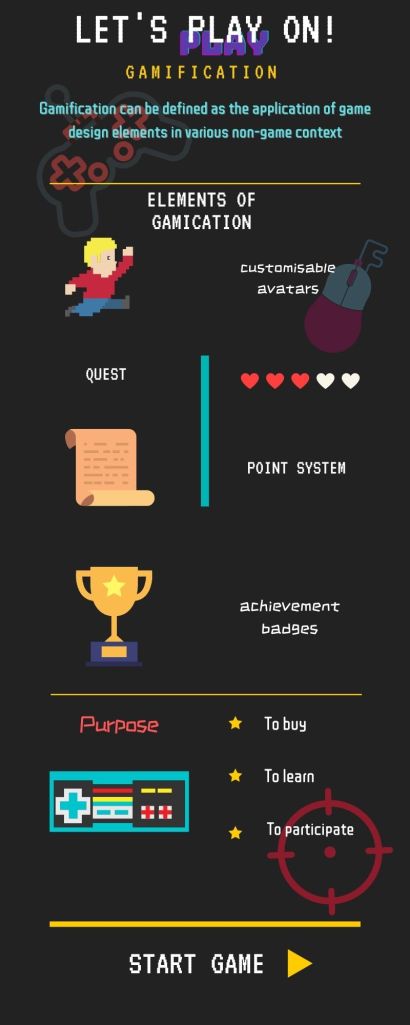
I played my first video game when I was five years old, it is Super Mario. I was deeply attracted by the plot and the avatars(Mario, Luigi’s, Toad!), the badges (like collect the coins to achieve the goals). Then other games came along. Video game became popular around the world. Gradually, people began to apply these attractive elements into various fields.
Gamification involves “using game-based mechanics, aesthetics and game thinking to engage people, motivate action, promote learning, and solve problems” (Kapp, 2012, p. 10) It usually applies to marketing, activism.health, business and education. This article will focus on gamification been used in education.
Let’s PLAY!
Why gamification are useful in education
At first, let’s think about why you can’t focus on your study…..
In my opinion, I think the biggest problem why I can not concentrate while studying is due to the lack of motivation and crises of engagement. Gamification in education aims to increase student engagement, motivate learning and facilitate students in the development of sustainable life skills. Because Games prompt powerful emotional responses such as curiosity, satisfaction and frustration (Kim, 2012, McGonigal, 2011). These emotions can improve engagement, and it can also promote you. The effect of gamification is to produce three factors that make your performance better. They are
- Autonomy
- mastery
- purpose
You can have specific aim in the study(quest) and game elements encourage you to do better.(achievements, leaderboard) You can be more self directed during your study process. When you finish the quest or pass the “boss fights” you feel satisfied.
Example of gamification in education
Minecraft–education
Minecraft is a popular video game, and it mainly composed of survival and construction. You can use the different cube to build anything you want.
Minecraft education edition offer a lesson plan and downloadable world to help teacher improve with engagement. Teacher can use the elements of the game like cube and construction to teach math lessons (volume & shape)and explore history buildings and explain their history through the use of Minecraft. All of these have effectively increased the quality of teaching, making students more active and enjoy learning.
Reference list
- Buckley, Patrick & Doyle, Elaine 2016, ‘Individualising gamification: An investigation of the impact of learning styles and personality traits on the efficacy of gamification using a prediction market’, Computers & Education, vol. 106, March 2017, pp. 43-55.
- Kapp, K.M. (2012). The Gamification of Learning and Instruction: Game-based Methods and Strategies for Training and Education. [online] Google Books. John Wiley & Sons. Available at: https://books.google.com.au/books?hl=en&lr=&id=M2Rb9ZtFxccC&oi=fnd&pg=PR12&ots=JyIk_83C2O&sig=bp8EozZ2ZojY7ngWSVn4PmkcDQc&redir_esc=y#v=onepage&q&f=false [Accessed 22 Apr. 2021].
- Kim, B 2012, ‘Harnessing the power of game dynamics1: Why, how to, and how not to gamify the library experience’, College & Research Libraries News, vol. 73, no. 8, pp. 465–469.
- Burmester, N. (2020). Top 5 Examples of Gamified Education. [online] Gamify. Available at: https://www.gamify.com/gamification-blog/top-5-examples-of-gamified-education [Accessed 16 Apr. 2021].
 Felix & MY