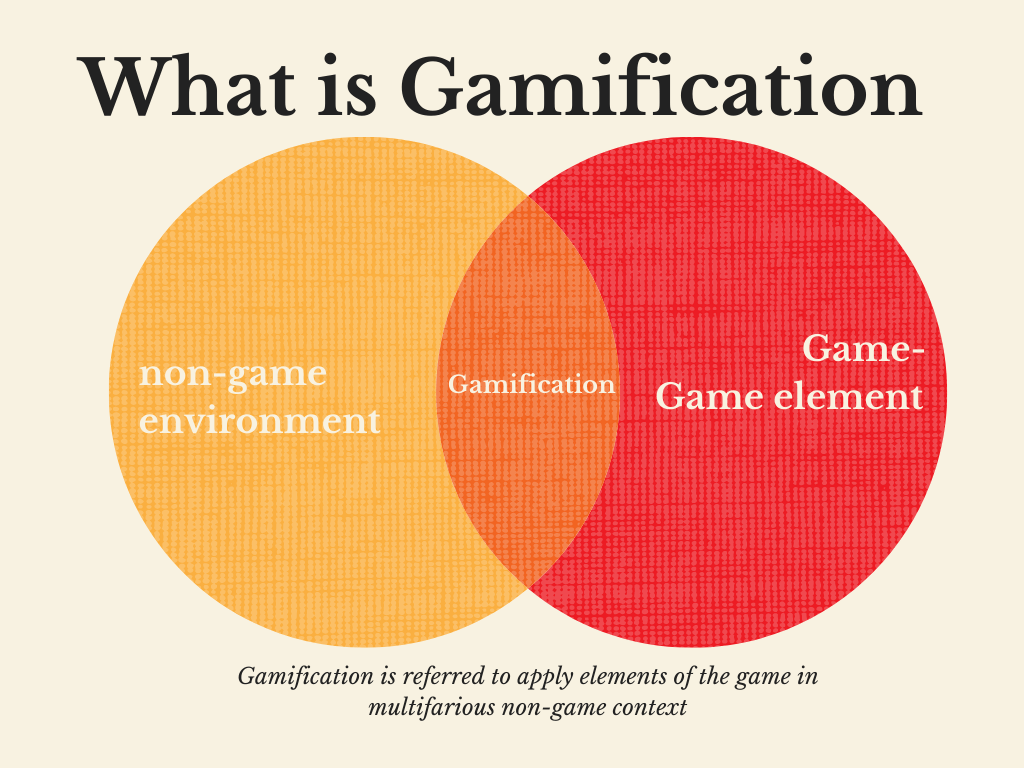
What is Gamification?
What is gamification? Gamification is about adding game mechanisms into a nongame environment, such as a business working space or learning system. It aims to make individuals interact and participate more with everything around them. For example, other co-workers, consumers and even the space they are in. The ultimate goal is to achieve better performance under a brisk atmosphere. Some academics believe gamification will “drastically improve our world by creating a society of healthier, more productive and engaged citizens” (Pavlus, 2010).
Gamification in workplace
In Steve Crabtree’s article published on Gallup news, he stated that under the Gallup’s new 142-country study on the State of the Global Workplace, only 13% of employees worldwide are engaged at work, 63% are “not engaged”, and the other 24% “actively disengaged”. This shows that workplace is becoming a dreadful space for the employees. Most of them are unwilling to be there. This has become a big global issue and indicates the workplace require a change. As stated in the article, “Business leaders worldwide must raise the bar on employee engagement.” Gamification is one of the solutions to this problem.
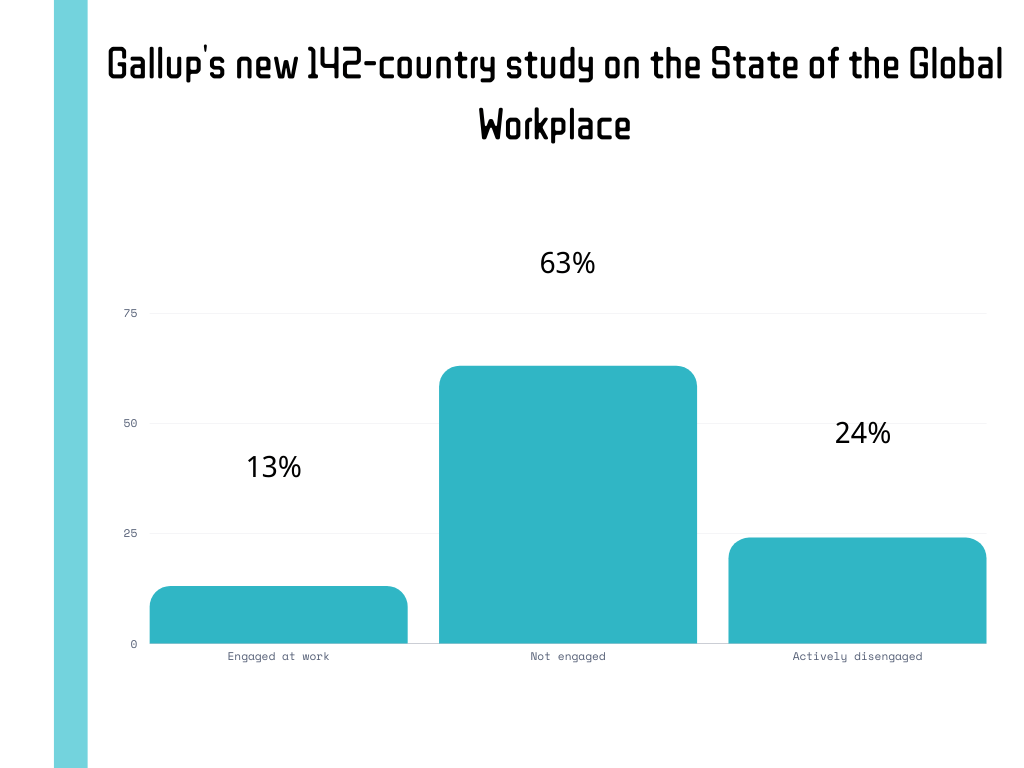
only 13% of employees worldwide are engaged at work, 63% are “not engaged”, and the other 24% “actively disengaged”.
Gamification is a great strategy for motivating employees in workplace, it can be applied into many situations where employees would require motivation. This will help to encourage better performances. The game mechanisms set out the goals more clearly and provides directions for employees to follow. It will also allow both managers and the employees to check the progress and identify issues. Some advantages of workplace gamification include satisfaction among workers, a measurable and seeable results, increased employee motivation.
When applying gamification in workplace, the rule should be clear, you should provide information to the employees with criteria, rewards and benefits. An example of gamification in workplace would be setting up a company- wide score board for workplace safety assessments and those who are doing well will get benefit. This will encourage the employees to pay attention reading the safety rules. Another example would be the ERP software. “These systems offer a holistic view of the organization because they reduce information redundancy, offer information in real time, help with process standardization, and improve information flow and communication among employees.” (Alcivar, Isabel & Abad, Andres G. 2016, ‘Design and evaluation of a gamified system for ERP training’, Computers in Human Behavior, vol. 58, May 2016, pp. 109-118.)
Some benefits include improved efficiency, customer service, a total visibility of the organization.
Gamification in consumer marketing
The three goals of applying gamification in consumer marketing is engagement, brand loyalty and brand awareness. (Lucassen, Garm & Jansen, Slinger 2014).
Engagement is defined as the emotional connection between consumers and the brand (Rappaport (2007), brand loyalty relates to the attitude and repeating purchase behavior, brand awareness focuses on providing brand knowledge to the end consumer and raising the awareness of brand name among the society.
A classic example of applying gamification into the marketing campaign would be a loyalty reward program. As your customer spends money, they will get points until it accumulates to a certain amount, they will get an extra discount. This helps to practice brand loyalty in their mind, providing a sense of belonging to this brand.
Gamification in production industry
In production industry, most manufactures would focus on safe and slow rather that new and intuitive. (Korn, Oliver & Schmidt, Albrecht 2015). This is why gamification hasn’t really been applied into this area. There are assistant systems such as the ERP, their role is to monitor the work progress and identify any quality problems during the production. There are lesser game elements in these systems. Another reason is that the gamification implements might become a distraction to the workers in their jobs, it could cause a decrease in concentration.
A concept for industrial gamification implementation was introduced in 2012 by Korn. This project focused on how to improve assistive system to provide a more positive working environment for the workers. The design was to keep the game elements simple so it would never be a distraction. After practicing this concept, the users provided positive feedback, they were more motivated by this method comparing to the previous. However, some would question its durability, will this motivation last after a longer period of time? Or whether the use’s productivity will decrease after the removal of the gamification implement
Do you have any examples of gamification for share ?
Share you opinion in comments!
Reference List
- Alcivar, Isabel & Abad, Andres G. 2016, ‘Design and evaluation of a gamified system for ERP training’, Computers in Human Behavior, vol. 58, May 2016, pp. 109-118.
2. Lucassen, Garm & Jansen, Slinger 2014, ‘Gamification in Consumer Marketing – Future or Fallacy?’, Procedia – Social and Behavioral Sciences, vol. 148, 25 August, pp. 194-202.
3. Korn, Oliver & Schmidt, Albrecht 2015, ‘Gamification of Business Processes: Re-designing Work in Production and Service Industry’, Procedia Manufacturing, vol. 3, pp. 3424-3431.
4.Gallup, I., 2021. Worldwide, 13% of Employees Are Engaged at Work. [online] Gallup.com. Available at: <https://news.gallup.com/poll/165269/worldwide-employees-engaged-work.aspx> [Accessed 29 April 2021].
5. Epic top 10.com .” 26 June 2019. A word cloud featuring “Business”. Available at: www.epictop10.com or https://www.flickr.com/photos/182229932@N07/48132648023/in/photolist-2gkjpkM-aETDnb-7VJyew-2hXVbWj-7VFiyz-9owXVu-529ogi-8doHmR-9TdCiS-52dCcw-5dyZVu-529maR-dbbuB6-4xT5Qg-6o36Hw-83NT3a-6zNTrZ-xuR7QS-8buUN9-7VFj44-6vQwbx-6F3WAV-bvRQ-9HkDJJ-2hbLaEc-7VFiPF-2k5ZdvK-7VFiJi-7VJyVu-HBNKUD-9owXVL-7VJyES-7rbSNe-XfXPXE-S9z9vm-5jc47c-p4zEUB-zK8HHm-9HoRKD-7aUTDP-8RYrvm-2qTWFf-3bM2V6-cgWum-8HHLnn-WDMXKJ-TgL2MS-7tSe1o-4zHzkL-ME2Cgd
 Felix & MY