Be yourself; Everyone else is already taken.
— Oscar Wilde.
This is the first post on my new blog. I’m just getting this new blog going, so stay tuned for more. Subscribe below to get notified when I post new updates.
Be yourself; Everyone else is already taken.
— Oscar Wilde.
This is the first post on my new blog. I’m just getting this new blog going, so stay tuned for more. Subscribe below to get notified when I post new updates.
Background
At first, the inspiration for this project came to me over a weekend. Everyone knows that in Melbourne, the weekend means getting together with friends or family : )
I also made an appointment to have dinner with my friends. During dinner, we drank liquor, and discussed with each other very much congenially. I even forgot my car was in the parking lot outside. Difficulties came at the end of the dinner, ‘How do I get my car home?’
At that instance, I thought about how the ride-sharing market seem to be ignoring those consumers who already have a car. Some friends and I decided to tap into this market and provide convenience for those who need a “chauffeur” for various reasons.
My start-up idea is an app to provide a designated driver service called ‘Chauffeur’. There will be three parties involved in the App, which is software platform, the driver and the customer.
This service will be provided to customers who are drunk or for any other reason are not in a position to drive their car to the intended destination.
The customer uses the App to order a designated driver.
The driver will drive the consumer’s vehicle to their destination.
This app will only act as a software platform to connect the driver to the customer. Drivers are certified by software that verifies their id information, and as an independent contractor rather than an employee of this start-up. The biggest difference from regular ride-sharing services is that the car is provided by the customer rather than the driver or application.
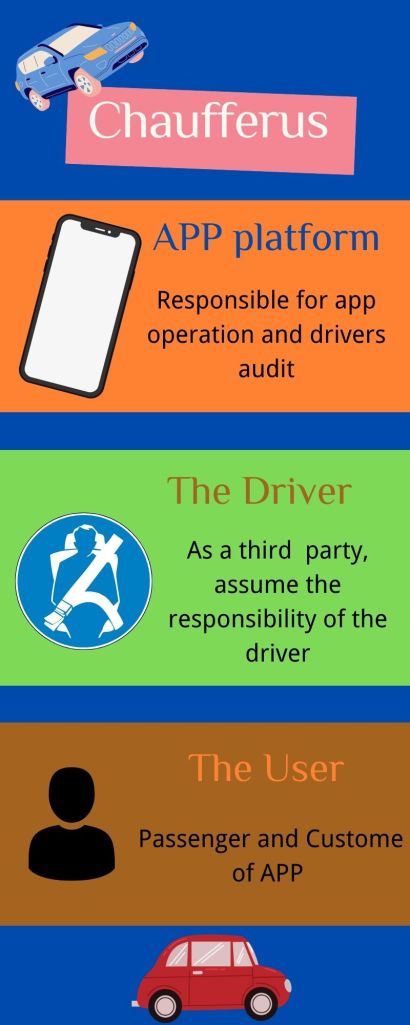
The main features will be similar to most software that offers ride-sharing services. There will be two versions of the software, Driver version and customer version.
In driver version, nearby consumers in need of service will be displayed and their passenger information as well as destination can be seen. You can choose the best match for you. Of course, you can also preset, such as the direction you want to go or the distance to drive, and the system will match you with the right customer.
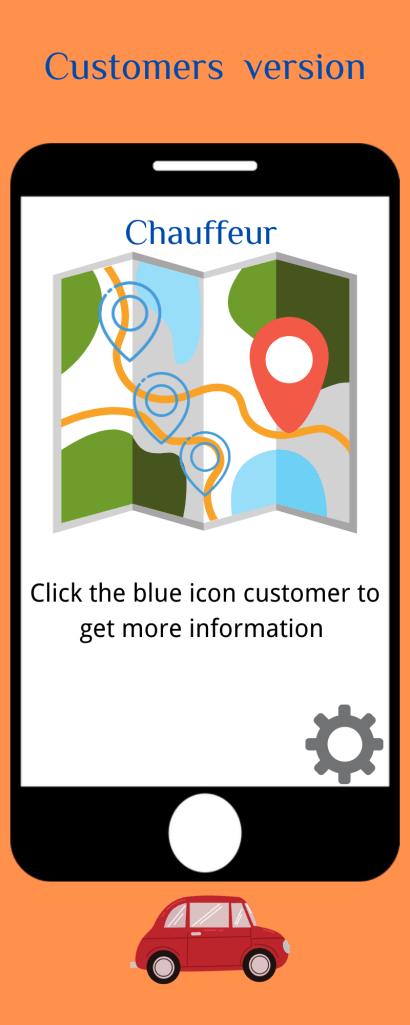
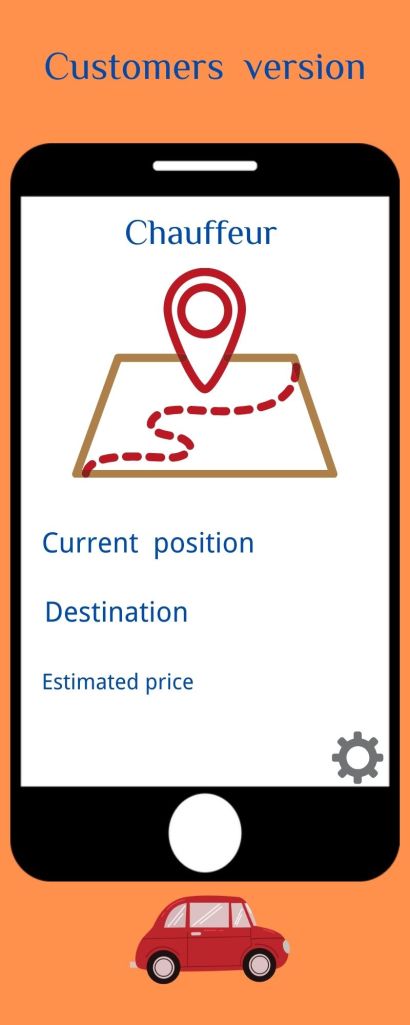
In customer version, you need to set up your itinerary, origin and destination. The system matches you with the driver, and of course you can see the driver’s information and make a decision about whether or not to accept the driver to drive your vehicle.
Scoring system has also been added to the application to give your passenger or driver a score and evaluation at the end of each trip. It is an intuitive way to see if this passenger/driver is good fit for you.
Chauffeur was founded by several university students. Some of us studies business and some of us studies media, that means we have an understanding of the market and digital media. We are all ambitious and confident in this project.
Now, we are in contact with a professional mobile application development team and working with them to build the App.
We have filled some of the gaps in the market
2. This app provides jobs opportunity for people who do not own cars.
This start-up idea is that it is a novel and innovative idea in the Australian ride-sharing industry, it limits competition to a great extent
The first risk of this start-up idea is how to get financing. Because it is a novel idea, is innovation. Compared to emulating other companies, it carries a higher risk, due to the reason that it is untested in the market. Investors will have more aspects to worry about.

The second risk is Chauffeurs need to compete in the ride-sharing market in Australia, but the competition is already “fierce”. We will face to more difficult as a start-up. This high risk is capable of blurring the strategic vision of this start-up and the ability to seize market opportunities.
We researched the market to avoid these risks. In interview, a large proportion of people with vehicle said they would use the App.
We will seize on the weaknesses of other mobile application to compete with other ride-sharing services, like security. Chauffeur will focus on the screening of drivers; strict audits will be conducted to ensure the safety of both drivers and customers. If the driver deviates from the GPS in tour vehicle, you will be alerted, and an automatic warning will be sent to the platform. We will keep an “eye” on your journey.
We Need You!
We hope you will continue to pay attention to our Application and help make “Chauffeurs” more professional.
You can also tag us on Twitter #CheuffeurMel, to evaluate or start-up.
If you have any investment intention, you are also welcomed to join us!

Reference list:
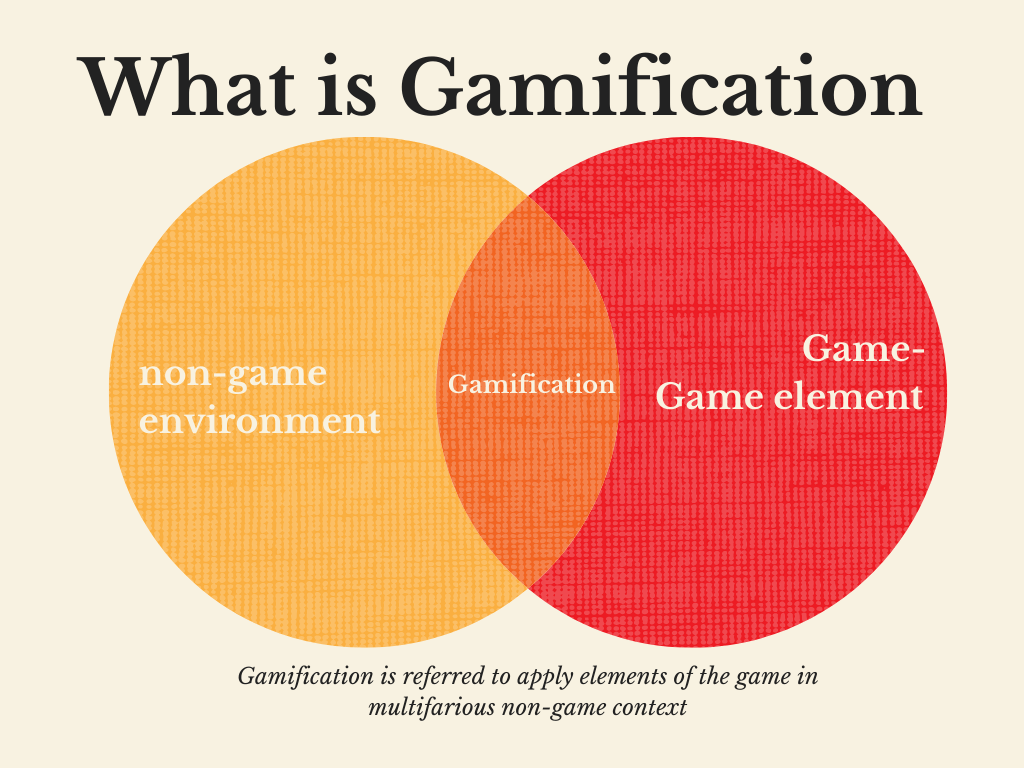
What is Gamification?
What is gamification? Gamification is about adding game mechanisms into a nongame environment, such as a business working space or learning system. It aims to make individuals interact and participate more with everything around them. For example, other co-workers, consumers and even the space they are in. The ultimate goal is to achieve better performance under a brisk atmosphere. Some academics believe gamification will “drastically improve our world by creating a society of healthier, more productive and engaged citizens” (Pavlus, 2010).
Gamification in workplace
In Steve Crabtree’s article published on Gallup news, he stated that under the Gallup’s new 142-country study on the State of the Global Workplace, only 13% of employees worldwide are engaged at work, 63% are “not engaged”, and the other 24% “actively disengaged”. This shows that workplace is becoming a dreadful space for the employees. Most of them are unwilling to be there. This has become a big global issue and indicates the workplace require a change. As stated in the article, “Business leaders worldwide must raise the bar on employee engagement.” Gamification is one of the solutions to this problem.
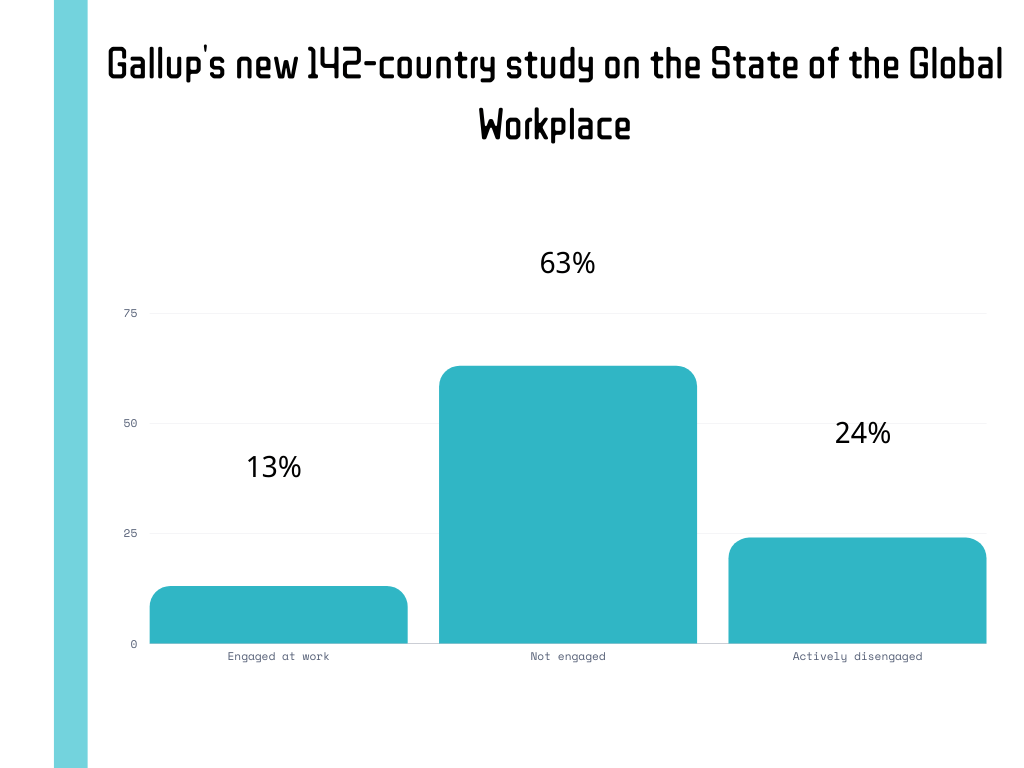
only 13% of employees worldwide are engaged at work, 63% are “not engaged”, and the other 24% “actively disengaged”.
Gamification is a great strategy for motivating employees in workplace, it can be applied into many situations where employees would require motivation. This will help to encourage better performances. The game mechanisms set out the goals more clearly and provides directions for employees to follow. It will also allow both managers and the employees to check the progress and identify issues. Some advantages of workplace gamification include satisfaction among workers, a measurable and seeable results, increased employee motivation.
When applying gamification in workplace, the rule should be clear, you should provide information to the employees with criteria, rewards and benefits. An example of gamification in workplace would be setting up a company- wide score board for workplace safety assessments and those who are doing well will get benefit. This will encourage the employees to pay attention reading the safety rules. Another example would be the ERP software. “These systems offer a holistic view of the organization because they reduce information redundancy, offer information in real time, help with process standardization, and improve information flow and communication among employees.” (Alcivar, Isabel & Abad, Andres G. 2016, ‘Design and evaluation of a gamified system for ERP training’, Computers in Human Behavior, vol. 58, May 2016, pp. 109-118.)
Some benefits include improved efficiency, customer service, a total visibility of the organization.
Gamification in consumer marketing
The three goals of applying gamification in consumer marketing is engagement, brand loyalty and brand awareness. (Lucassen, Garm & Jansen, Slinger 2014).
Engagement is defined as the emotional connection between consumers and the brand (Rappaport (2007), brand loyalty relates to the attitude and repeating purchase behavior, brand awareness focuses on providing brand knowledge to the end consumer and raising the awareness of brand name among the society.
A classic example of applying gamification into the marketing campaign would be a loyalty reward program. As your customer spends money, they will get points until it accumulates to a certain amount, they will get an extra discount. This helps to practice brand loyalty in their mind, providing a sense of belonging to this brand.
In production industry, most manufactures would focus on safe and slow rather that new and intuitive. (Korn, Oliver & Schmidt, Albrecht 2015). This is why gamification hasn’t really been applied into this area. There are assistant systems such as the ERP, their role is to monitor the work progress and identify any quality problems during the production. There are lesser game elements in these systems. Another reason is that the gamification implements might become a distraction to the workers in their jobs, it could cause a decrease in concentration.
A concept for industrial gamification implementation was introduced in 2012 by Korn. This project focused on how to improve assistive system to provide a more positive working environment for the workers. The design was to keep the game elements simple so it would never be a distraction. After practicing this concept, the users provided positive feedback, they were more motivated by this method comparing to the previous. However, some would question its durability, will this motivation last after a longer period of time? Or whether the use’s productivity will decrease after the removal of the gamification implement
Do you have any examples of gamification for share ?
Share you opinion in comments!
Reference List
2. Lucassen, Garm & Jansen, Slinger 2014, ‘Gamification in Consumer Marketing – Future or Fallacy?’, Procedia – Social and Behavioral Sciences, vol. 148, 25 August, pp. 194-202.
3. Korn, Oliver & Schmidt, Albrecht 2015, ‘Gamification of Business Processes: Re-designing Work in Production and Service Industry’, Procedia Manufacturing, vol. 3, pp. 3424-3431.
4.Gallup, I., 2021. Worldwide, 13% of Employees Are Engaged at Work. [online] Gallup.com. Available at: <https://news.gallup.com/poll/165269/worldwide-employees-engaged-work.aspx> [Accessed 29 April 2021].
5. Epic top 10.com .” 26 June 2019. A word cloud featuring “Business”. Available at: www.epictop10.com or https://www.flickr.com/photos/182229932@N07/48132648023/in/photolist-2gkjpkM-aETDnb-7VJyew-2hXVbWj-7VFiyz-9owXVu-529ogi-8doHmR-9TdCiS-52dCcw-5dyZVu-529maR-dbbuB6-4xT5Qg-6o36Hw-83NT3a-6zNTrZ-xuR7QS-8buUN9-7VFj44-6vQwbx-6F3WAV-bvRQ-9HkDJJ-2hbLaEc-7VFiPF-2k5ZdvK-7VFiJi-7VJyVu-HBNKUD-9owXVL-7VJyES-7rbSNe-XfXPXE-S9z9vm-5jc47c-p4zEUB-zK8HHm-9HoRKD-7aUTDP-8RYrvm-2qTWFf-3bM2V6-cgWum-8HHLnn-WDMXKJ-TgL2MS-7tSe1o-4zHzkL-ME2Cgd
I played my first video game when I was five years old, it is Super Mario. I was deeply attracted by the plot and the avatars(Mario, Luigi’s, Toad!), the badges (like collect the coins to achieve the goals). Then other games came along. Video game became popular around the world. Gradually, people began to apply these attractive elements into various fields.
Gamification involves “using game-based mechanics, aesthetics and game thinking to engage people, motivate action, promote learning, and solve problems” (Kapp, 2012, p. 10) It usually applies to marketing, activism.health, business and education. This article will focus on gamification been used in education.
Let’s PLAY!
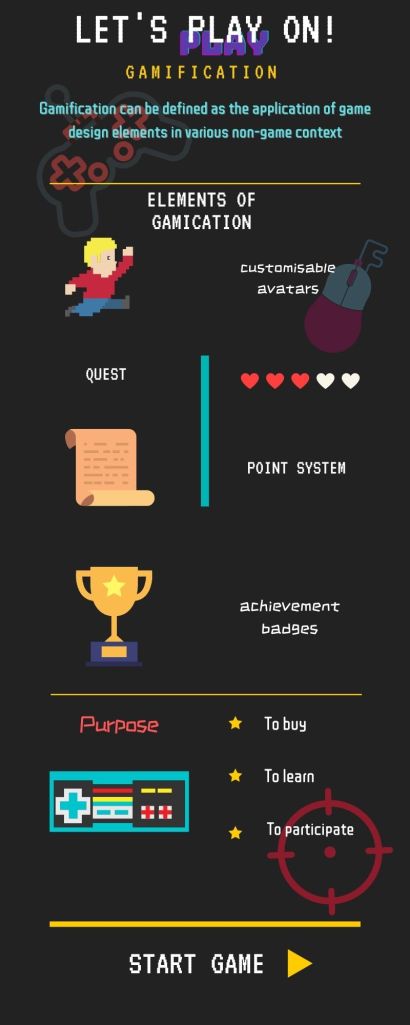
At first, let’s think about why you can’t focus on your study…..
In my opinion, I think the biggest problem why I can not concentrate while studying is due to the lack of motivation and crises of engagement. Gamification in education aims to increase student engagement, motivate learning and facilitate students in the development of sustainable life skills. Because Games prompt powerful emotional responses such as curiosity, satisfaction and frustration (Kim, 2012, McGonigal, 2011). These emotions can improve engagement, and it can also promote you. The effect of gamification is to produce three factors that make your performance better. They are
Minecraft–education
Minecraft is a popular video game, and it mainly composed of survival and construction. You can use the different cube to build anything you want.
Minecraft education edition offer a lesson plan and downloadable world to help teacher improve with engagement. Teacher can use the elements of the game like cube and construction to teach math lessons (volume & shape)and explore history buildings and explain their history through the use of Minecraft. All of these have effectively increased the quality of teaching, making students more active and enjoy learning.
Reference list
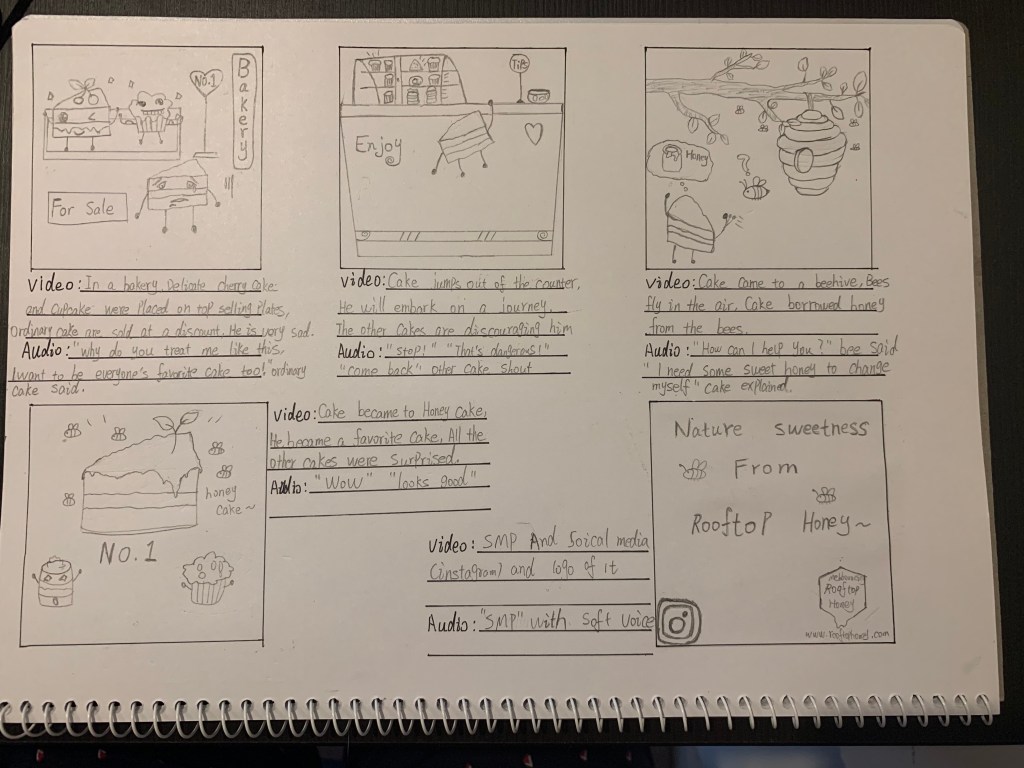
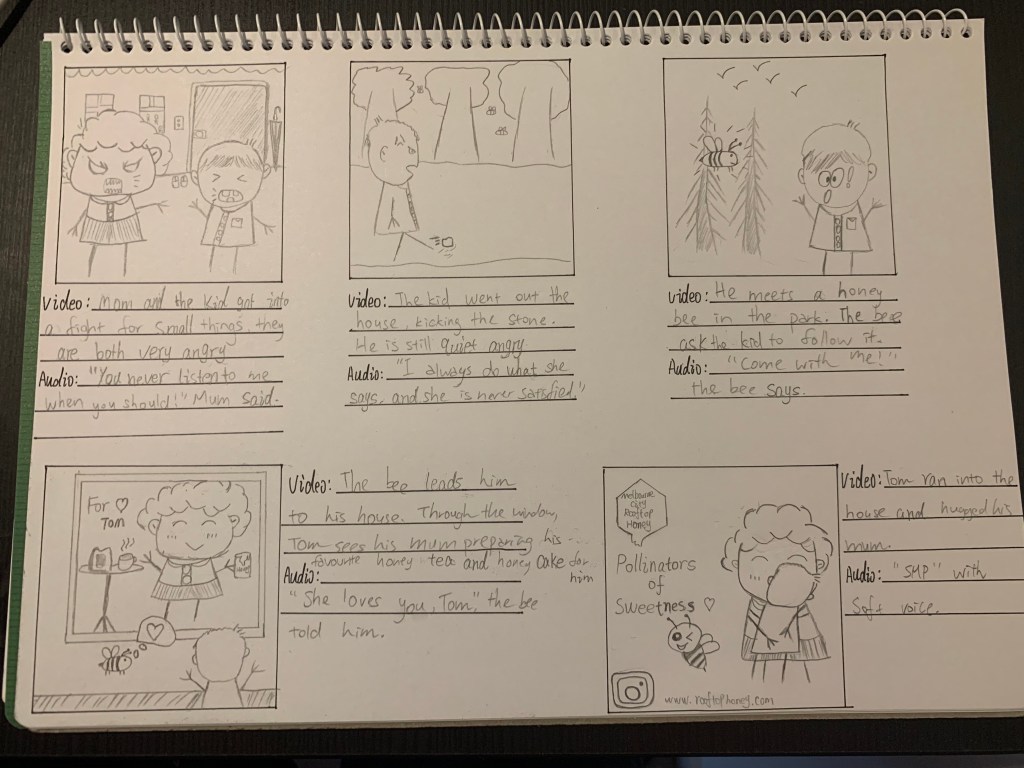
https://www.rooftophoney.com.au
Background
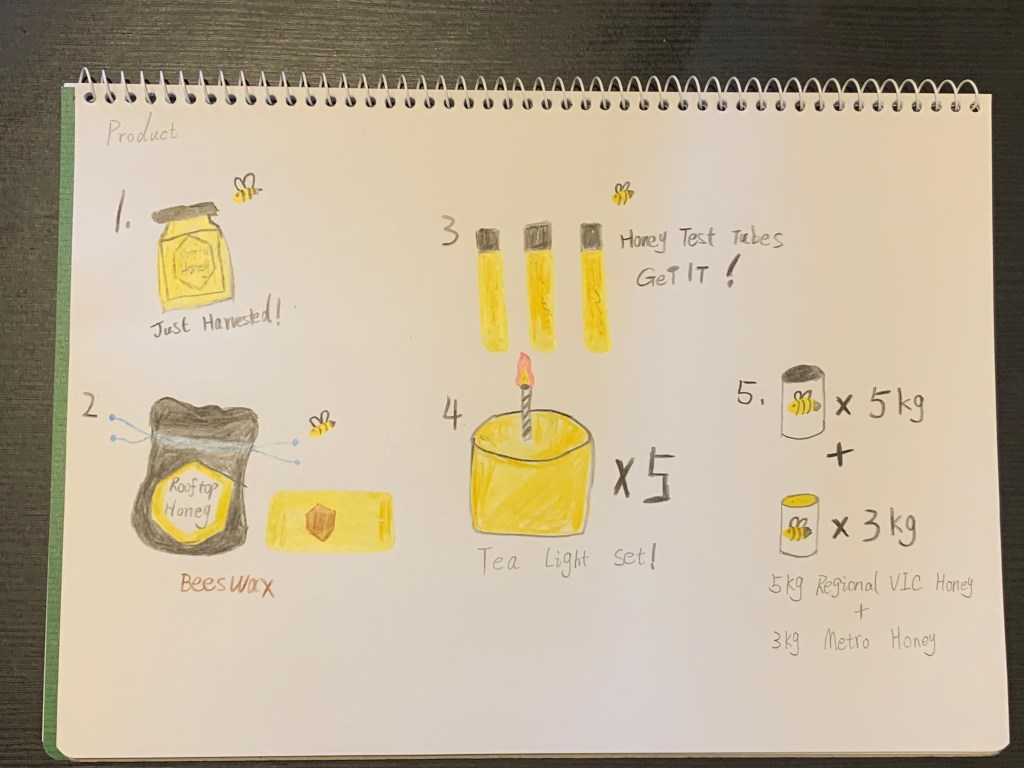
Rooftop honey is a company started in Melbourne in 2010. Their goal is to raise the awareness of the importance of bees in our society. The rooftop honey aims for the problem of sustainability. Bees have a really significant place for guaranteeing biodiversity in our world. 75% of our crops depend at least in part on bees. (Barilla centre July 19, 2019) In the current state, bees population is largely decreasing. Rooftop honey focuses on bringing the bees and honey into our daily life and promoting local honey sales. Australia is the fourth largest exporter of honey in the world after China, Argentina and Mexico. This industry is a huge contributor to the economic develop of rural areas. (Victoria Farmer’s Federation, 2019) The Australia honey industry now produces around $90 million annually. In an average year, Australian beekeepers produce between 25,000 and 30,000 tonnes of honey. (Australian honey bee industry council) The rooftop honey are bringing and their brand into city by placing hives on the roof space of shops, restaurants, cafes etc. These are places people would visit in their everyday life, the customers can see how their honey are made. The price of rooftop honey is $14.95 per 280g, and ethical honeys are $14.95 per 500g. They also have various bee wax products for sale. This price is acceptable for most people. However, this year is a hard year for everyone. The Covid-19 hit Melbourne hard, with all the shops closed and people home bound, it will be very hard to sell local honey. However, the rooftop honey can use this as an opportunity to put the idea of “supporting the local” out, hence helping to recover local economy. This brand very much fits the image of the nurturer, ‘driven by their need to protect and care for others’ (Sparkol 2015). When we think of honey, it is always very heart warming, and with the idea of helping sustainability in our society, and providing support to the community after the hit of Covid-19, it will fit the rooftop honey brand the most.
Objectives
The rooftop honey can attract customers through affection. By connecting to the customers emotionally, the customers are more likely to purchase their product, as by purchasing they are also helping the planet’s economic environment and saving the bees. The idea of how small actions by us can change the big world is heart touching.
Target audience
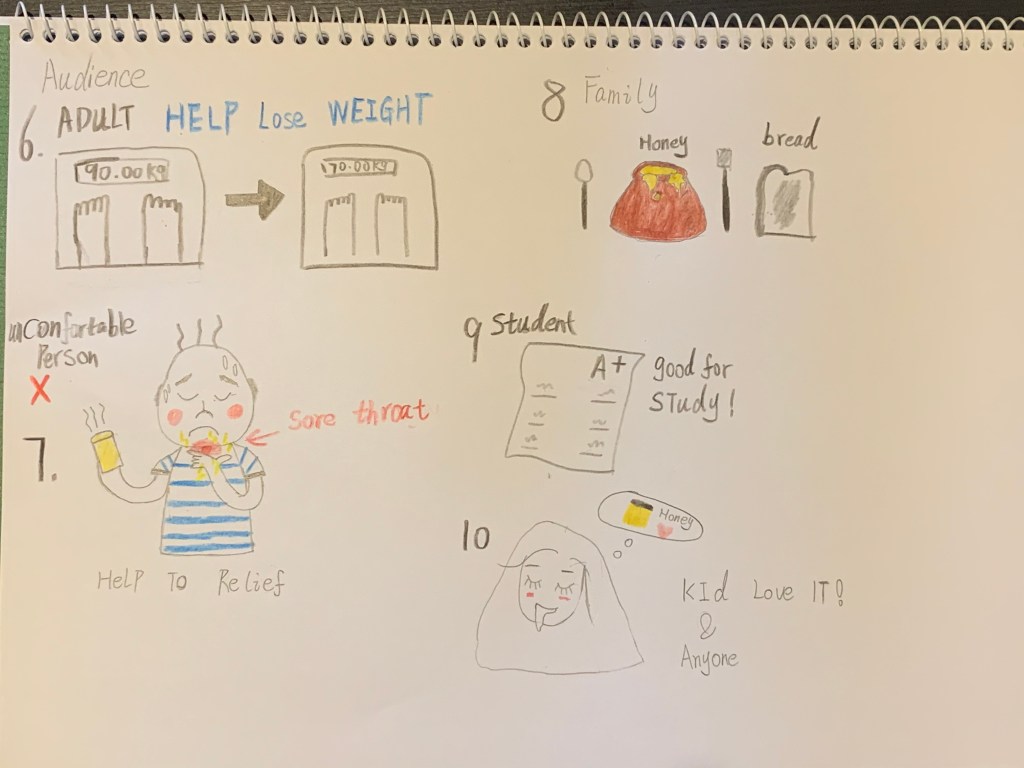
The target audience will be most Melbourne’s residents, aged 35-44, both male and female, which is 14.3% of the 439,087 population in Melbourne. (Australian Bureau of Statistics, 2019) The audience should be working either part-time or full-time, earning a salary above 50,000 p.a. These people would be very conscious to the environmental issues and are willing to pay for eco friendly products. These audiences will buy the rooftop honey’s products. They will be very happy to know that they helped the world to become a better place.
Single minded proposition
“LOVE from rooftop”
“The sweetness starts on the ROOFTOP”
“Natural sweetness from rooftop”
“Eco Bees”
“Pollinators of sweetness”
Substantiation
“Bees and other pollinating insects are indispensable for guaranteeing biodiversity and achieving Sustainable Development Goals. But they seriously risk extinction.” (Barilla Centre, 2019)
“We need bees. We may take them and other pollinators like butterflies and hoverflies for granted – but they are vital for stable, healthy food supplies. They are key to the varied, colourful and nutritious diets we need and have come to expect. “(Friends of the earth, 25 Jul 2017)
There are more than 800 wild bee species within Europe, seven of which are classified by the International Union for Conservation of Nature (IUCN) as critically endangered. A further 46 are endangered, 24 are vulnerable and 101 are near threatened. (The Conversation, August 2019)
Tone of voice
Bees are facing extinction, you have the power within you grip to save them, will you do it or not?
Media requirements
30 seconds instastory
Mandatory
Logo, SMP, Social media (Instagram, Facebook) and website address
Reference list
Sparkol 2015, ‘The 12 brand archetypes all successful businesses are built on’, weblog post, 1 September, retrieved 3 May 2020, <https://www.sparkol.com/en/blog/the-12-brand-archetypes-all-successful-businesses-are-built-on>
Barilla Center 2019’Save the bees for a sustainable development’retrieved July 19, 2019,<https://www.barillacfn.com/en/magazine/food-and-sustainability/save-the-bees-for-sustainable-development/>
Victoria farmers federation 2019,’HONEY PRODUCTION IN AUSTRALIA’ retrieved 2019<https://www.vff.org.au/vff/Industries/Horticulture/Beekeepers/Honey_Production_in_Australia/vff/Industry_Groups/Horticulture/Beekeepers/Honey_Production_in_Australia.aspx?hkey=bbb529de-9155-4a9f-b513-dd5fff5ad336>
Philip Donkersley 2019, ‘Bees: how important are they and what would happen if they went extinct?‘, retrieved 20 August 2019,<https://theconversation.com/bees-how-important-are-they-and-what-would-happen-if-they-went-extinct-121272>
Friends of the earth, ‘ why do. we need bees? ‘ , retrieved 25 Jul 2017 , <https://friendsoftheearth.uk/bees/why-do-we-need-bees>
Regional Population by Age and Sex, Australia, 2019, Victoria, retrieved 28 August 2020, <https://www.abs.gov.au/AUSSTATS/abs@.nsf/Latestproducts/3235.0Main%20Features152019?opendocument&tabname=Summary&prodno=3235.0&issue=2019&num=&view=>
Australian Bureau of Statistics 2018, 2016 Census QuickStats: Greater Melbourne,Australian Bureau of Statistics, retrieved 3 May 2020, <https://quickstats.censusdata.abs.gov.au/census_services/getproduct/census/2016/quickstat/2GMEL?opendocument>
Australian honey bee industry council 2014, The future of the beekeeping and pollination service industries in Australia, retrieved 31 march 2014, <www.honeybee.org.au>
STEP 1 Facebook outdoor advertisement
Headline: Fake news is not our friend.
New Body : We employing fact-checker globally and improve cutting-edge technology for identifying fake news. Bringing you the authentic news is our responsibility.
Call to action: Find out how we’re addressing the spread of fake news by going to fb.me/fbchangesAU
Insert: Facebook logo
Step 2 (reducing it to 6-10 words): We check the facts so you can enjoy the authentic news.
Step 3: Identifying problems in advertisement:
step 4 : creating headline
Mothers aged 30 – 50
Step 5: Chosen headline
Your family is at home instead of on your phone
I will choose this one,“Your family is at home instead of on your phone”. Because in my target audience , everyone CARES about their family very much. And this headline is simply and explicitly tell the audience do not text and drive. It will alert them.
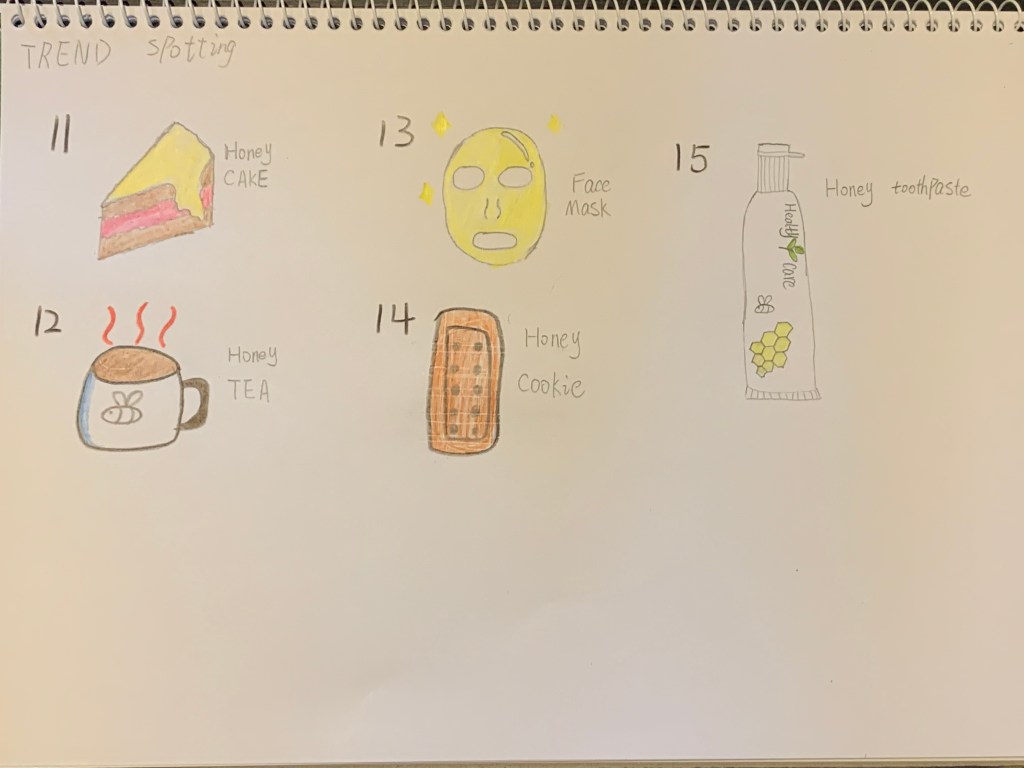
Rooftop Honey
product
Audience
Trend spotting
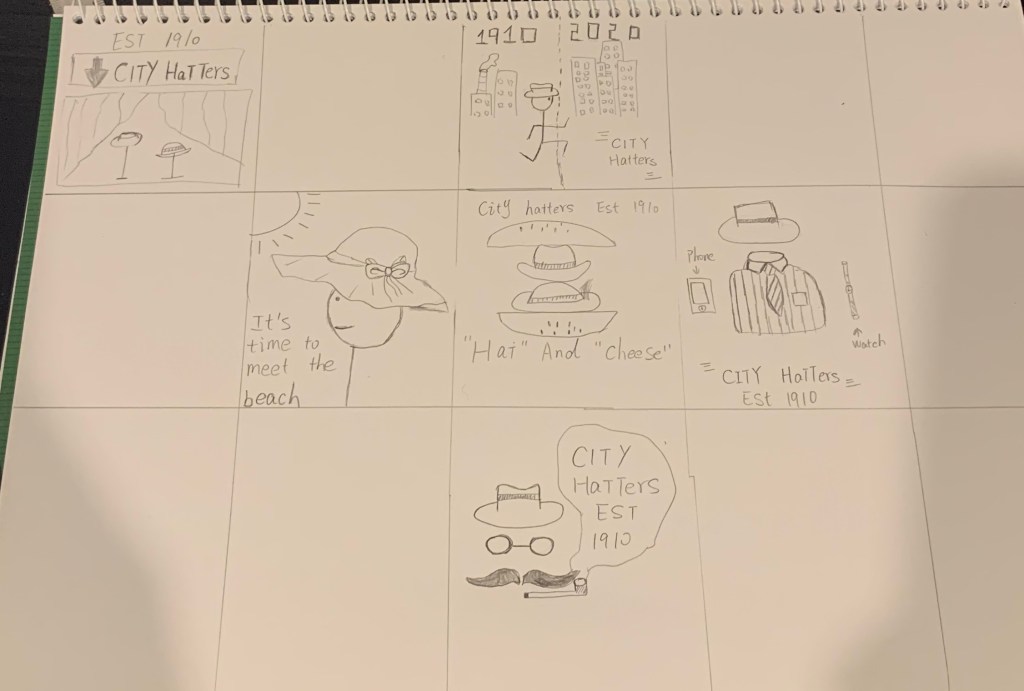
This week we need to research a hat brand which is called City Hatters https://www.cityhatters.com.au
Background: city hatters is a shop in Melbourne that sells a variety of hats. And it is over a hundred years.
Target audience: young people, between 20-30. Be interested in fashion.
objectives: Increase awareness and let more people know about the store. Encourage customer to purchase the product.
Background
The avozilla is new to the fresh good category and, aside from some news coverage, there is very little awareness. The product is in direct competition with regular avocado varieties, which have a lower price point. Potentially the concern may arise that a bigger avocado might not taste as good as well-known varieties. It should be noted that Australian consumers are often open to trying to products, i.e. they have a low risk avoidance (Hofstede Insights n.d.). The avozilla brand will reflect the attributes of the warrior archetype, as it has benefits for those with an ‘alpha’ outlook who work hard at saying on top of their busy, health-focused lives.
Proposition
Made big for your healthy lifestyle
Substantiation
• You get 18 slices out of the avozilla, as opposed to 4 in a regular avocado
• Delicious buttery taste with all the same good fats and vitamins as other varieties
Tone of voice
Powerful, energising, positive.
Media requirements
Television, social media display ads, outdoor.
Mandatories
Logo, web address.
16 different LOGO
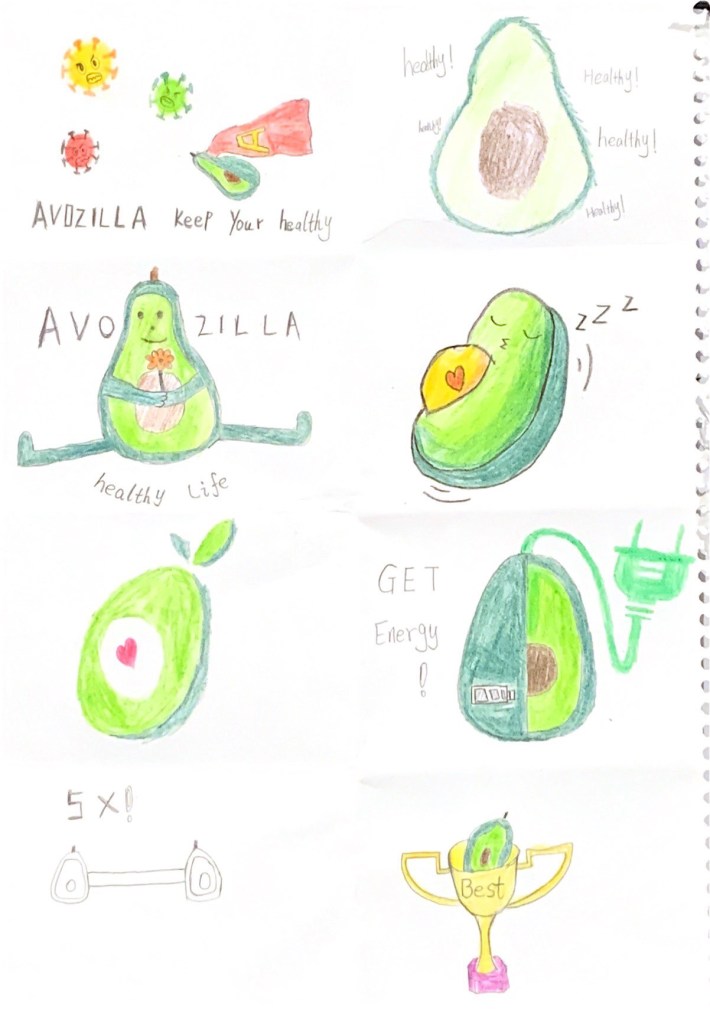
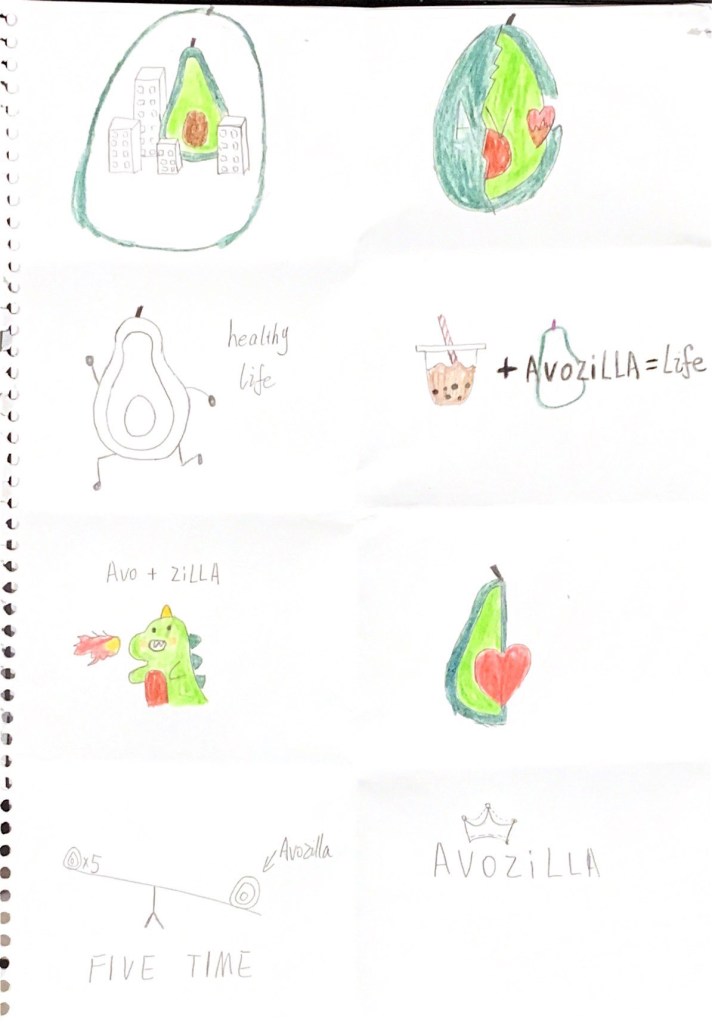
TOP 3 Design
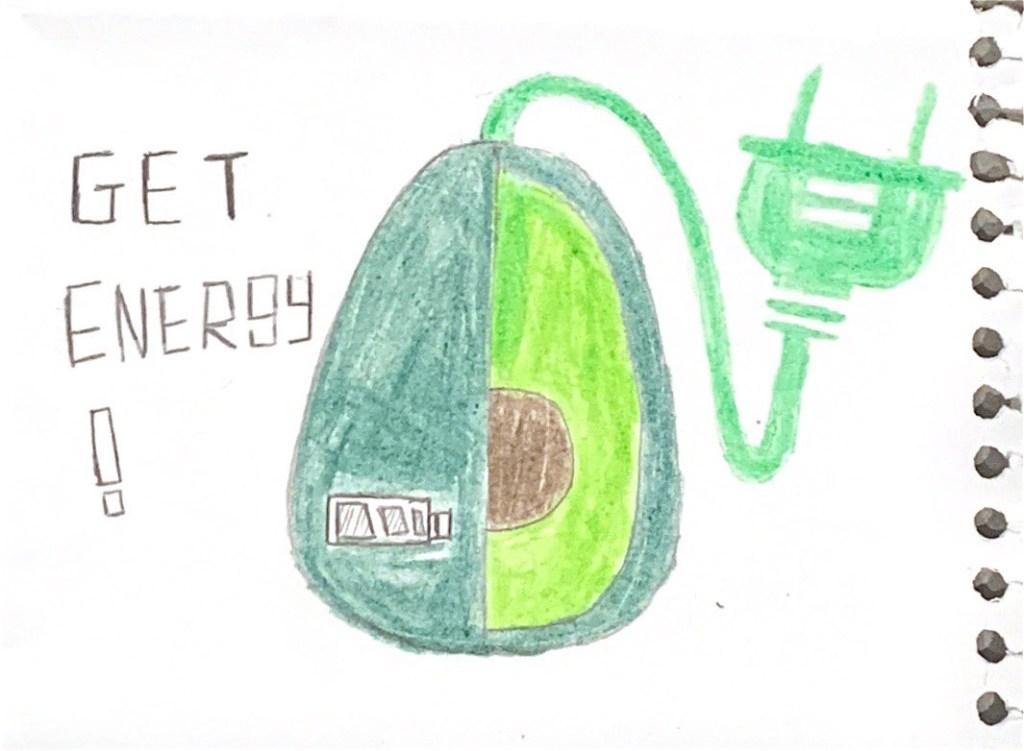
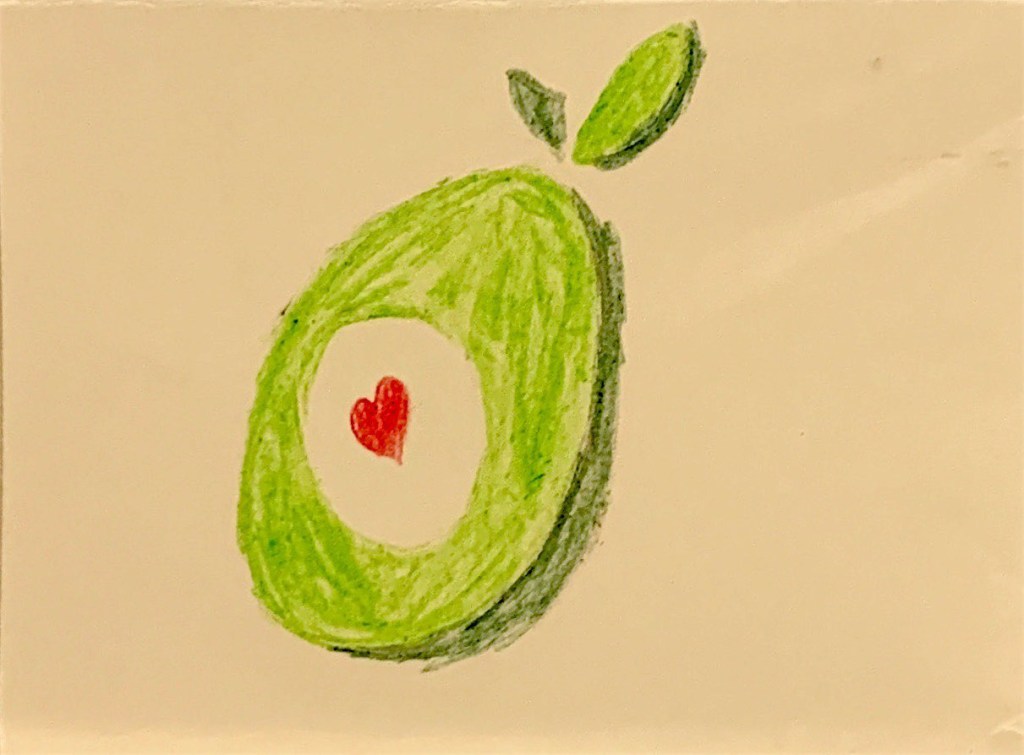
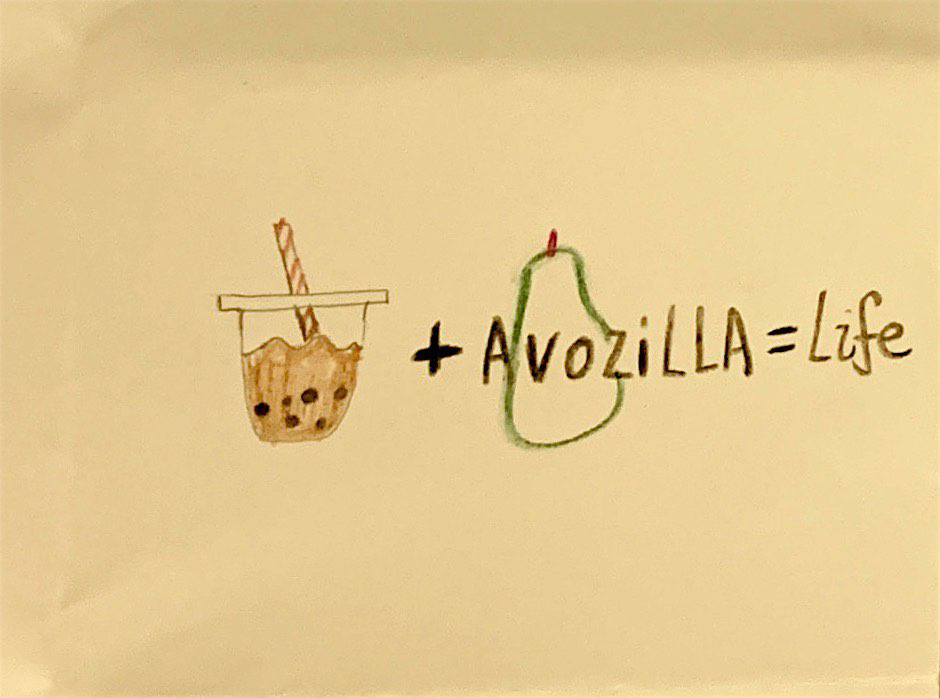
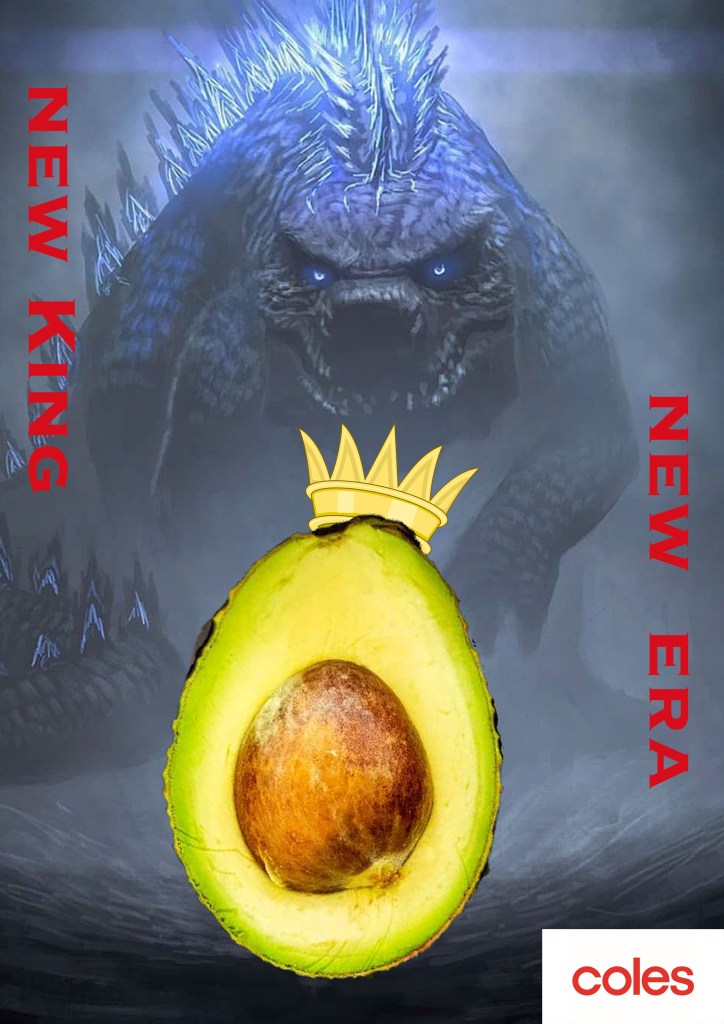
In first one, I still use the element of Godzilla. Godzilla is the king of the monster, and Avozilla is king of the avocado. as well as Godzilla show the obedience to Avozilla.
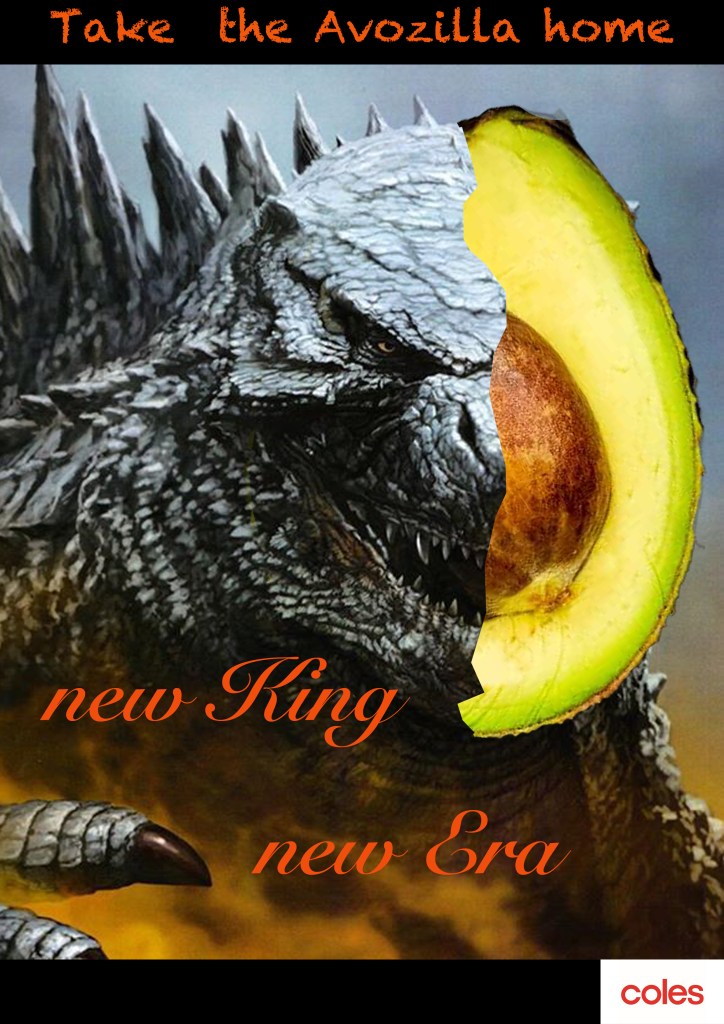
Second one, I also use Godzilla to create the poster. I want to tell audience, they are king of the monster and avocado, respectively.
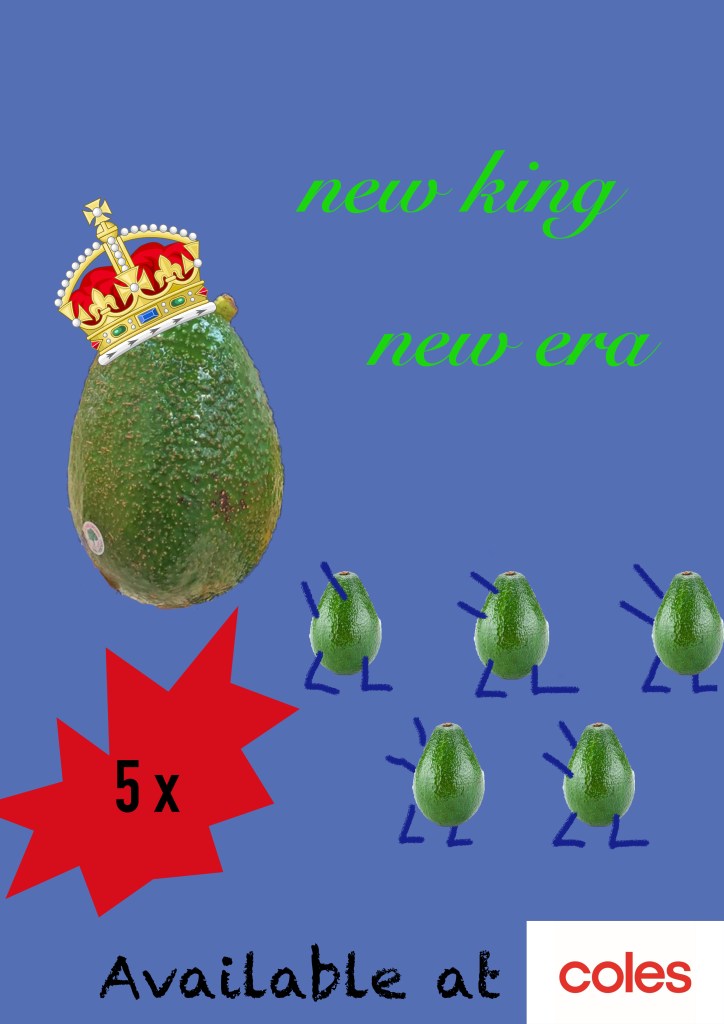
last one, I add some comedy factor. Because Avozilla is 5 time of regular Avocado, so the avocado kneel on the floor and show obedience to the new “KING”